 ELEKTROENERGETIKA |
VESTI FIRME |
BAZA EE EE BLOG |
DOGAĐAJI FAKULTETI |
KNJIGE ČASOPISI |
POSLOVI LINKOVI |
SISTEMI ISTORIJAT |
  |  |
 |
| KNJIGE NA ENGLESKOM
EEE
EEE
SLEDEĆA > N.K. Sterling - Handbook of Power Distribution and Transmission Engineering G.R. Whitmore - Protective Relay Testing and Commissioning A.J. Murray - Substation Engineering Handbook J. Radosavljević - Metaheuristic Optimization in Power Engineering. Volume 1 J. Radosavljević - Metaheuristic Optimization in Power Engineering. Volume 2 B. Badrzadeh - Power System Dynamic Modelling and Analysis in Evolving Networks P. Schavemaker - Electrical Power System Essentials A. von Meier - Electric Power Systems: A Conceptual Introduction G. Rogers - Power System Oscillations G. Rigatos - Intelligent Control for Electric Power Systems and Electric Vehicles
EEEEEE
SLEDEĆA >
NEW WEBSITE ABOUT POWER SYSTEMSPrikaz 1 do 10 od ukupno 250 knjiga na engleskom NEWS, EVENTS, BOOKS, BLOG, UNIVERSITIES  |
A.J. Murray - Substation Engineering Handbook Substation Engineering Handbook: A Step-by-Step Practical Guide to High-Voltage Design, Grounding, Protective Relaying, Automation, Testing, and Maintenance by Alfred J. Murray (Author) Publisher : Independently published Publication date : September 17, 2026 Language : English Print length : 506 pages 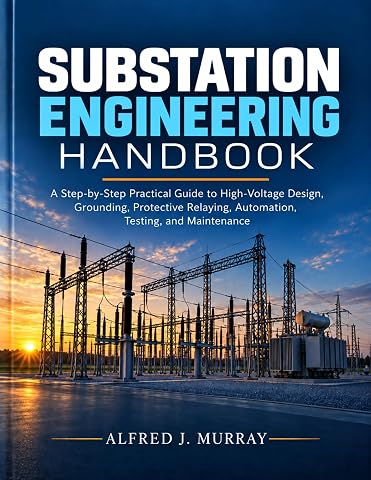 A substation is the one place in a power system where every branch of electrical engineering stops being a separate subject. Most engineers never study it as a subject. Power systems courses treat the station as a node on a diagram. Protection courses cover relays and settings, not the yard around them. Civil and structural work sits in another department. Then a general arrangement drawing lands on the desk and the questions arrive at once: where that clearance came from, what fault current the ground grid must carry, why the breaker is rated as it is, and what changes if the transformer impedance does. The reasoning that connects those answers is rarely written down. It is picked up in fragments, over years, from whoever sits nearby. This handbook puts it in one place. It follows a substation from the decision to build through site selection, layout, equipment specification, insulation coordination, grounding, shielding, protection, control and automation, into commissioning, maintenance and replacement. Each chapter produces the quantity the next one needs, so the numbers arrive understood. Inside this engineering reference: Fourteen chapters that build a complete station in sequence, each with objectives, summary and key equations More than ninety worked examples, solved with every intermediate step and unit, so each can be defended in a design review Practice problems with verified answers in every chapter Ground grid design end to end: soil model, grid current, touch and step voltages, conductor sizing, resistance, mesh voltage and transferred potential Fault studies with symmetrical components, equipment duty verification, incident energy and arc-flash boundaries Bus arrangements, clearances, air- and gas-insulated construction, insulation levels, surge arresters and rolling sphere shielding Specification-level treatment of transformers, reactive plant, breakers, disconnect switches and instrument transformers, with burden and saturation Protection schemes, distance and pilot elements, breaker failure and coordination, station battery and trip circuit, automation, timing and cybersecurity Commissioning, insulation and oil diagnostics, protection and ground grid testing, maintenance and asset management Five appendices: conversion factors, voltage and insulation classes, soil resistivity and conductor data, relay device numbers and commissioning checklists, plus glossary and index The treatment is quantitative and practical, from North American practice, with dimensions in customary and metric form. Methods are derived rather than asserted, and newer work sits alongside the classical: inverter-based resources, collector and storage interconnections, and the digital station. Written for substation design engineers, protection and control engineers, consultants, utility and plant engineers, commissioning technicians, and students entering a design office. It assumes a reader who will verify every method and apply it under a responsible approval process. 
|